
Compressed air is hailed as the “fourth utility” of modern industry, finding widespread application in sectors such as manufacturing, food processing, pharmaceuticals, electronics, automotive, and chemicals. However, when purchasing compressed air systems, many enterprises focus primarily on the compressor itself while overlooking the issue of moisture content.
In reality, even a high-performance air compressor cannot deliver the high-quality air required for production without a suitable compressed air dryer. Water vapor in the air concentrates during the compression process and condenses into liquid water as temperatures drop; this not only corrodes piping and equipment but can also compromise product quality, leading to production downtime and financial losses.
Therefore, selecting a compressed air dryer tailored to specific industry needs not only enhances equipment reliability and reduces long-term operating costs but also ensures that products meet industry standards.
Compressed Air Dryer Basics
What is a compressed air dryer? A brief overview of working principles
An air dryer for compressors is a device used to remove water vapor from compressed air. Its primary function is to reduce the moisture content of the air to a specified pressure dew point (PDP) prior to its entry into the production system.
Different types of dryers employ various dehumidification methods:
- Refrigerated dryers: Use a refrigeration system to lower the air temperature, causing water vapor to condense and be drained away.
- Adsorption dryers: Use adsorbents—such as activated alumina or molecular sieves—to capture moisture from the air.
- Membrane dryers: Selectively remove water vapor using specialized hollow-fiber membranes.
- Hybrid dryers: Combine refrigeration and adsorption technologies to achieve higher efficiency.
To learn more about the complete clean air system, please read our Comprehensive Guide to Clean Dry Air (CDA) for a full overview of the components and applications of clean compressed air systems.
Why is a compressed air dryer needed?
Pressure dew point is a key parameter for assessing the dryness of compressed air; it refers to the temperature at which condensation begins to occur under a specific pressure. When the ambient temperature of the system falls below the air’s pressure dew point, moisture separates from the airflow to form liquid water or ice, thereby causing a range of process and equipment issues.
The primary hazards associated with moisture in compressed air systems include:
- Corrosion of internal pipe walls and air receiver tanks, accelerating air leaks and piping network failure.
- Sticking or jamming of valves, cylinders, spray guns, and precision instruments, resulting in unstable operation or malfunction.
- Reduced surface quality in processes such as coating, laser cutting, and electrostatic dust removal, leading to defects like pinholes, color variations, and poor adhesion.
- Product contamination, excessive bacterial counts, or circuit board damage due to moisture absorption in industries such as food processing, pharmaceuticals, and electronics.
Selecting the appropriate air dryer for air compressor and maintaining the pressure dew point within process specifications can significantly reduce these risks. When combined with a filtration system, this can achieve the overall quality goal of “Clean Dry Air” (CDA).
Impact of Improperly Dried Air on Production
When a dryer is undersized or operating conditions are mismatched, common issues include:
- Increased production line downtime and unscheduled maintenance, leading to a decline in OEE (Overall Equipment Effectiveness).
- Frequent malfunctions in equipment driven by compressed air, resulting in significantly higher maintenance and spare parts costs.
- Reduced pass rates in downstream processes—such as coating, printing, and packaging—along with higher rates of rework and scrap.
- Potential regulatory issues in the food and pharmaceutical industries, including failure to meet relevant cleanliness or hygiene standards.
These hidden costs often far exceed the dryer’s initial purchase price and operating expenses. Therefore, when evaluating the Total Cost of Ownership (TCO), factors such as “product costs and downtime losses attributable to air quality” should be taken into account to ensure a more rational budget for the dryer’s grade and configuration.
Comparison of Common Types of Compressed Air Dryers
Refrigerated Air Dryer
Refrigerated dryers operate on the principle of refrigeration-based dehumidification. They cool compressed air to a pressure dew point range of approximately 3–10°C, causing water vapor to condense into liquid water, which is then separated and discharged. Featuring a mature design and relatively low cost, this type of dryer is a common choice for general manufacturing and the automotive industry.
Typically providing a pressure dew point of around 3°C, it meets the requirements for pneumatic tools, general air supply, and basic process applications in most indoor environments. Non-cycling units provide continuous cooling with a simple, reliable design, whereas variable-speed and energy-saving models adjust cooling capacity to reduce energy consumption, making them suitable for systems with fluctuating loads.
Further details regarding advantages and application scenarios can be found in the article “What is the function of a refrigerated air dryer?”
https://www.youtube.com/embed/DUyA8B_BpBg?si=0LQP9C-VPxlLcy11
Sollant refrigerated air dryer
Desiccant Air Dryer
Desiccant dryers utilize the selective moisture-adsorption capabilities of desiccants (such as molecular sieves or activated alumina). Through an alternating dual-tower process of adsorption and regeneration, they can achieve pressure dew points as low as -20°C, -40°C, or even lower. They are the primary solution when low dew points (below 0°C) are required and are essential equipment for meeting ISO 8573 standards for low moisture content.
Desiccant dryers typically operate on the Pressure Swing Adsorption (PSA) principle: one tower adsorbs moisture while the other undergoes regeneration using a portion of the depressurized, dried air. The towers switch periodically to ensure a continuous air supply. In situations where ambient temperatures might drop below the dew point achievable by refrigerated dryers—such as with outdoor piping networks or in cold-climate applications—desiccant dryers are often the only viable drying solution.
Membrane Dryer
Membrane dryers achieve drying by utilizing the selective permeability of hollow-fiber membranes to water vapor, separating a portion of the moisture from the compressed air and venting it into an external exhaust stream. Compact and requiring no power supply, they are well-suited for applications involving low flow rates, decentralized points of use, instrument air, and mobile equipment. Compared to refrigerated and adsorption dryers, membrane dryers typically offer lower processing capacities and require more rigorous pre-filtration; they also often entail a certain percentage of “purge” loss (using a sweep gas to remove moisture), making them uneconomical for high-flow main distribution systems. However, they are highly valuable in space-constrained applications requiring continuous, stable operation, such as analytical instrument rooms or remote monitoring sites.
Combined Dryers
Combined dryers typically integrate or connect different drying technologies—such as refrigeration, adsorption, and membrane separation—in series. A common example is the “refrigeration + adsorption” configuration, where a refrigerated dryer removes the bulk of the moisture, followed by a small adsorption tower that polishes the air to achieve an ultra-low dew point. This approach reduces the load on the adsorbent, lowers regeneration energy consumption, and extends the lifespan of the desiccant.
For systems requiring both low dew points and overall energy efficiency, hybrid drying solutions strike an optimal balance between performance and cost. They are frequently employed in industries demanding high-quality Clean Dry Air (CDA)—such as pharmaceuticals, electronics, and specialized coating processes—to ensure a stable dew point despite seasonal changes and fluctuations in load.
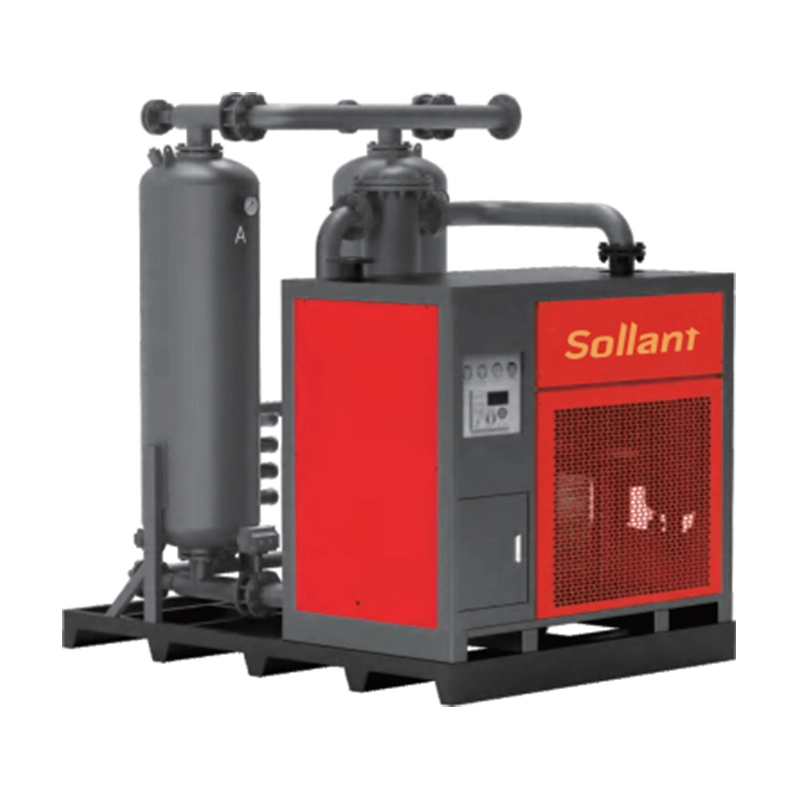
Comparison Table of Common Dryer Types
| Dryer Type | Typical Pressure Dew Point Range | Initial Cost | Energy Consumption Level | Maintenance Complexity | Typical Application Scenarios |
| Refrigerated air dryer | Approx. 3–10°C | Moderate | Moderate; varies with inlet air temperature | Low to moderate; primarily heat exchanger cleaning and condensate drainage maintenance | General manufacturing, automotive assembly, pre-treatment for painting/coating, general pneumatic tools |
| Adsorption air dryer | Below 0°C; typically -20°C, -40°C, or even lower | Relatively high | Relatively high; significant energy consumption for regeneration air or heating | Medium to high; requires periodic replacement or regeneration of the desiccant | Food, beverage, pharmaceuticals, electronics, outdoor piping networks, cold regions |
| Membrane dryer | Dew point control for low flow rates, down to below 0°C | Moderate | Primarily purge air loss; low or no electrical power requirement | Low to moderate; requires maintaining upstream filtration quality | Instrument air, low-flow point-of-use applications, mobile or distributed applications |
| Combined dryer | Covers a range from 3°C to ultra-low dew points, depending on configuration | Higher initial cost, but reduces total cost of ownership (TCO) | Optimized overall energy consumption can be lower than that of standalone adsorption systems | Medium to high; high level of system integration | Suitable for high-cleanliness, high-stability applications such as pharmaceuticals, electronics, precision coating, and multi-process industrial facilities |
Key Factors to Consider When Selecting a Compressed Air Dryer
Selecting the right model is not merely about purchasing a piece of equipment; it is a systems engineering task. The following factors are all essential.
Industry-Specific Dew Point Requirements
The dew point is a critical metric. According to the ISO 8573-1:2010 standard, Class 1 requires a pressure dew point of ≤-70°C, while Class 4 requires +3°C. Food and beverage applications may require Class 1 or 2, whereas general manufacturing often suffices with Class 4 or 5. An excessively low dew point incurs unnecessary costs, while one that is too high poses significant risks.
Air Flow Rate (m³/min) and System Pressure
The dryer’s processing capacity must match the air compressor’s output, typically with a 10–20% safety margin. Higher inlet pressure improves drying performance, but the equipment’s rated pressure range must be verified. Excessive flow rates can raise the dew point, while insufficient flow leads to inefficiency.
Energy Efficiency and Operating Costs
Operating costs often far exceed the initial purchase price. Refrigerated dryers offer low energy consumption but have limited dew point capabilities; among adsorption dryers, “zero-purge” blower-heated models provide significant energy savings. Calculate annual energy consumption (electricity, purge air loss, and maintenance) to select the most cost-effective solution.
Installation Environment (Space, Temperature, Humidity)
High-temperature and high-humidity environments reduce the efficiency of refrigerated dryers; in confined spaces, membrane or vertical adsorption dryers are preferable. Outdoor installations require considerations for rain protection, freeze protection, and ventilation.
Ease of Maintenance and Service Life
Opt for reputable brands and consider factors such as replacement intervals for filter elements and adsorbents, as well as intelligent monitoring capabilities. High-quality equipment can last over a decade and entails lower maintenance costs.
Certification Standards (Food-Grade, Pharmaceutical-Grade, ISO 8573, etc.)
The food and beverage industry requires compliance with FDA or 3A sanitary standards and oil-free, sterile designs; pharmaceuticals require GMP certification; the electronics industry prioritizes cleanliness. Prioritize products that are ISO 8573 certified.
Compressed Air Dryer Selection Recommendations by Industry
Manufacturing / Automotive Industry
Operations primarily involve pneumatic tools, painting, and assembly. Refrigerated dryers (dew point +3°C to +7°C) generally suffice; downstream filters are used to ensure cleanliness. For precision component machining, a combined (hybrid) dryer system may be selected.
Food & Beverage Industry (Emphasis on Oil-Free and Sterile Conditions)
Requirements are extremely stringent; moisture fosters microbial growth, while oil contaminates products. Oil-free compressors paired with adsorption or combined dryers (dew point ≤ -40°C) are recommended, along with activated carbon and sterile filtration. Strict adherence to HACCP and relevant regulations is essential to ensure “clean, dry air.”
Pharmaceutical & Medical Industries
Requires ultra-low dew points (-40°C to -70°C) and a sterile environment. Adsorption dryers are the standard choice, complemented by multi-stage filtration and online monitoring. Equipment materials must be corrosion-resistant and easy to clean, complying with GMP and ISO 8573 Class 1 standards.
Textile & Electronics Industries
The textile industry prioritizes anti-static properties and dryness, while the electronics industry is highly sensitive to particulates and moisture. Membrane or low-dew-point adsorption dryers suit low-flow precision processes, whereas combined systems are suitable for large-scale production lines.
Chemical & Petroleum Industries
Operating environments are harsh and highly corrosive. High-performance adsorption dryers made of corrosion-resistant materials are required; low dew points are necessary to prevent pipeline freezing or process anomalies. Safety certifications (such as ATEX explosion-proof ratings) are mandatory.
Construction & Painting Industries
Requires high mobility and adaptability to varying working conditions. Portable refrigerated or membrane dryers are recommended due to their durability and shock resistance. Painting processes require low dew points to prevent defects in the paint finish.
How to Select the Right Size Compressed Air Dryer
Key steps for sizing and selection:
- Calculate the system’s maximum flow rate (m³/min) and apply a safety factor of 1.1–1.2.
- Determine inlet temperature, pressure, and ambient conditions, and consult the manufacturer’s performance curves.
- Account for future expansion needs by allowing for a capacity margin.
- Simulate dew point performance under varying load conditions.
- Consult a professional engineer or use the manufacturer’s sizing software.
Incorrect sizing can lead to inefficiency or frequent start-stop cycling, increasing the risk of failure.
Pitfalls to Avoid When Selecting a Compressed Air Dryer
- Focusing solely on price while ignoring quality: Low-priced products often entail high energy consumption and a short service life, leading to higher long-term costs.
- Neglecting pre-treatment: Substandard upstream filters can contaminate the dryer and shorten its lifespan.
- Improper installation: Issues such as the lack of bypass valves, poor drainage, or cramped installation spaces can cause problems; refer to our installation diagrams for a proper layout.
- Overlooking energy audits: Failure to evaluate annual operating costs.
- Lack of brand reliability and after-sales support: Choose a manufacturer with a comprehensive service network to ensure the timely availability of spare parts.
- Failing to account for variable operating conditions: Significant fluctuations in production load require solutions such as intelligent variable-frequency drives or parallel multi-unit configurations.
Conclusion
Selecting the most suitable compressor air dryer requires a comprehensive evaluation of industry requirements, process parameters, cost-effectiveness, and long-term reliability. Refrigerated dryers are suitable for most standard applications, whereas adsorption and membrane dryers meet high-end needs; hybrid models offer a flexible, balanced solution. By considering the type comparisons, key factors, and industry recommendations outlined in this article, businesses can avoid common selection pitfalls and ensure the efficient, stable operation of their compressed air systems.
Source: Sollant
No comment